Living intentionally doesn’t mean doing more — it means creating small systems that make life feel lighter.
For me, that looks like a simple weekly reset routine I can actually stick to. It’s not a full-house deep clean, and it definitely doesn’t take hours. In fact, most weeks I’m done in 15–30 minutes.
This routine helps me start the week feeling calm, prepared, and less overwhelmed — without sacrificing my entire Sunday.
If you’ve ever gone into Monday feeling behind, scattered, or frustrated with yourself, this reset might be exactly what you need.
Why I Started a Weekly Reset
For a long time, my weeks felt chaotic before they even started. Meals were unplanned, the kitchen felt cluttered, laundry piled up, and I spent too much time deciding what needed to be done.
I realized the problem wasn’t motivation — it was decision fatigue.
Now, instead of trying to “catch up” all week, I spend a small pocket of time resetting the basics. This routine supports my life instead of adding pressure.
What a Weekly Reset Is (And What It Isn’t)
This reset is:
- Simple
- Flexible
- Focused on function, not perfection
It is not:
- A full cleaning schedule
- A productivity competition
- A reason to feel guilty if you miss it
Some weeks I do everything. Some weeks I only do two things. Both still count.
My Simple Weekly Reset Routine
1. A Quick Kitchen Reset (5–10 Minutes)
I always start in the kitchen because it has the biggest impact on my mindset.
This includes:
- Clearing the countertops
- Loading or emptying the dishwasher
- Wiping down surfaces
- Taking out the trash if needed
I don’t scrub appliances or deep clean — this is just about starting the week with a functional space.
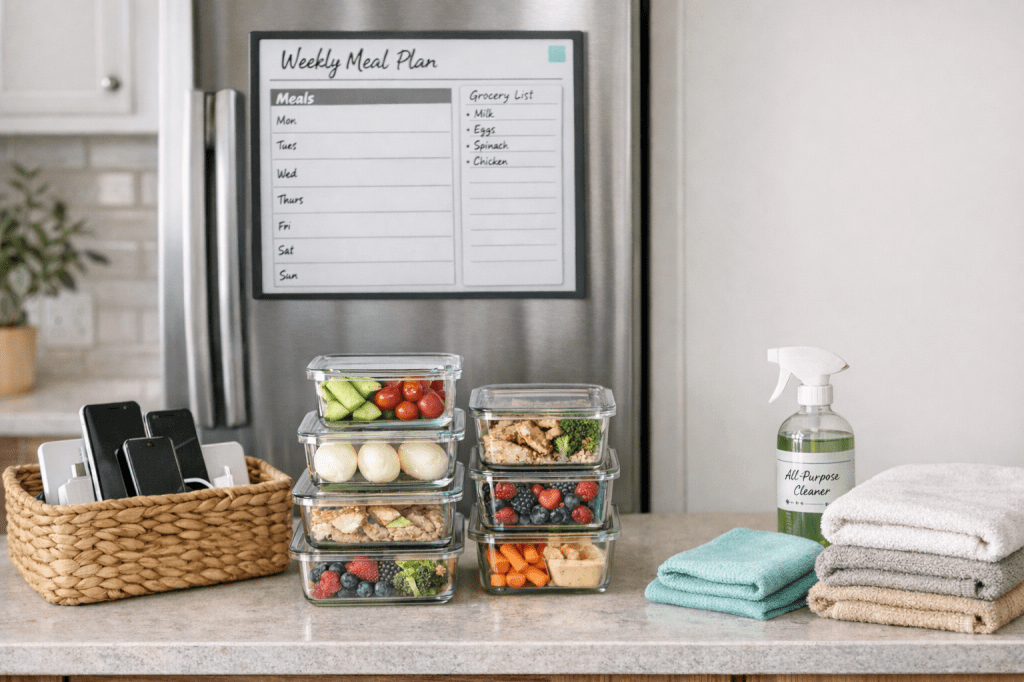
I use this all-purpose spray because it’s cruelty-free, smells delightful, and is gentler than many other kitchen cleaners. Pairing it with a microfiber cloth makes wiping down counters and surfaces quick, easy, and streak-free — perfect for my weekly kitchen reset.
2. Plan Meals in Under 10 Minutes
I don’t plan elaborate meals. I rotate the same simple breakfasts, lunches, and dinners each week with small variations.
My process:
- Choose 2–3 proteins for the week
- Decide on easy sides
- Plug meals into the same meal framework I always use
This keeps grocery shopping fast and eliminates daily “what’s for dinner?” stress.
This magnetic meal planner helps me quickly plan meals for the week while also keeping track of the groceries we need.
3. Prep What I Can (Without Overdoing It)
This isn’t full meal prep every week. I focus on high-impact prep:
- Washing and chopping produce
- Cooking proteins (often in the air fryer)
- Portioning snacks or lunches into glass containers
Even 10 minutes of prep saves me so much mental energy during the week.
Using glass meal prep containers helps me stay on track because they stack neatly in the refrigerator and make it easy to grab meals as I’m heading out the door in the morning. Seeing everything clearly also helps reduce food waste and keeps me consistent throughout the week.
An air fryer simplifies protein prep and cuts down on cleanup time. It allows me to quickly cook chicken, vegetables, or sides without turning cooking into a big production — which makes sticking to my meal plan feel manageable, even on busy days.
4. Choose My Movement for the Week
Instead of deciding every day how I’ll move my body, I decide once for the week.
I ask myself:
- Will I walk?
- Will I do short at-home workouts?
- Is this a low-energy week where consistency matters more than intensity?
Making the decision ahead of time removes pressure and helps me stay consistent without burnout.
On busy days, a walking pad makes it easy to fit movement in at home — whether that’s a quick walk while dinner cooks or steps during the workday. It eliminates the all-or-nothing mindset and helps me stay active even when time is limited.
When I want to increase the challenge without adding extra time, I add a weighted vest to my walks. It boosts calorie burn and strength-building while still keeping movement simple and low impact.
5. One Load of Laundry (Start or Finish)
I don’t aim to conquer all laundry. I just move it forward:
- Start one load
- Fold what’s already clean
- Put away clothes that are lingering
Progress is better than perfection.
6. Reset My Essentials
Before the week starts, I do a quick check:
- Refill water bottles
- Charge devices
- Restock snacks
- Set out workout clothes
These tiny actions make mornings smoother and reduce stress.
My Stanley cup is my go-to for staying hydrated. With its 40-oz capacity, insulated design, and leak-proof lid, it fits seamlessly into my day — whether I’m running errands, at my desk, or heading out for a walk.
I use a charging dock to keep counters clutter-free while making sure everyone’s devices stay charged and ready to go.
How Long This Actually Takes
On average: 15–30 minutes
On busy weeks: 10 minutes
On slower weeks: 45 minutes max
The key is consistency, not intensity.
Why This Routine Works
- It removes unnecessary decisions
- It supports real life, not an ideal version of it
- It creates momentum without pressure
- It aligns with intentionally living simply
This reset doesn’t make my life perfect — it makes it manageable.
If You Want To Try This Yourself
- It removes unnecessary decisions
- It supports real life, not an ideal version of it
- It creates momentum without pressure
- It aligns with intentionally living simply
This reset doesn’t make my life perfect — it makes it manageable.
Final Thoughts
This simple weekly reset has changed the way my weeks feel. Instead of constantly catching up, I start from a place of calm and clarity.
And that, to me, is what intentionally living simply is all about.
 Intentionally Living Simply
Leave a comment